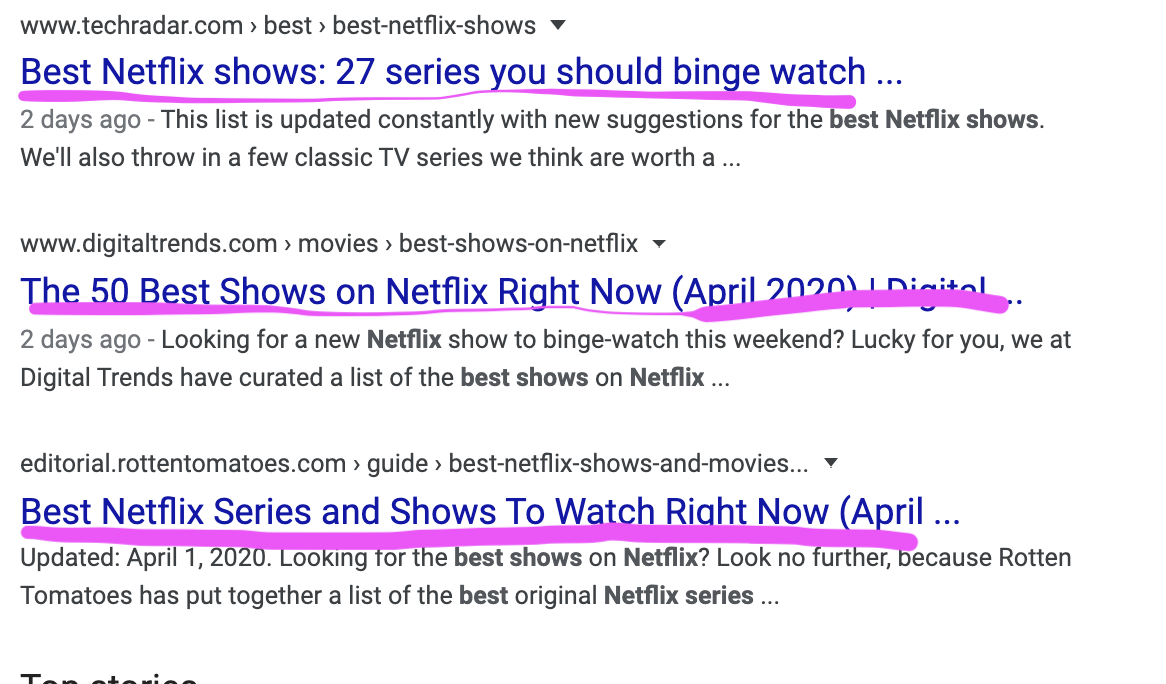
You’ll notice these title tags all include the primary keyword I searched “best Netflix shows,” and they are also self-explanatory to a reader. Title tags are not the time for a catchy headline. Instead, write something that includes your keyword and is straight to the point.
Write an informative meta description
Your meta description is the short blurb of content under the title tag that tells your readers what the blog post is about. Meta descriptions should be between 155-160 characters (not words) long. They should include your primary keyword and a short description of what the reader will get when they click through to your blog post. I also like to add a quick call-to-action (CTA) in the meta description to entice readers to click. Remember, readers like to be told what to do.
3. Engage readers so they stay on your website
Another way to build website credibility is to engage your readers and get them to stay on your website.
Believe it or not, most users only stay on a website for 10-20 seconds. I know, sad. Your job as a top-notch copywriter (especially for your high-end clients) is to employ copywriting tactics that will get visitors to engage with the website.
Here are some ideas on how you can keep your readers on your website.
Don’t be boring
That’s all.
Write for the internet
Writing for the internet is nothing like writing a novel, a school paper, or a review. When you write for the internet, you write how internet browsers read. This means:
Put the most important information first
Make it easy to scan your content by including headings, subheadings, and bullet points
Write in short paragraphs
Highlight your call-to-action (CTA)
Internet readers skim. Make it easy for them to scan your content and glean all the important insights.
Include internal links
You don’t necessarily need visitors to stay on a particular blog post, but you do want them to stay on your website.
A good way to do this is to include internal links to your website when it makes sense.
For example, if you are writing a blog post about freelance writing and you have a section where you talk about services, include a link to your services page (see what I did there?).
4. Get website visitors to convert
Content marketing is all about using content to capture more customers and eventually boost sales. The end goal of your post should be to get your website visitors to do something. (Quick note: this means you should always ask your clients what their content marketing goals are and what the purpose of the blog post is).
There are so many strategies for increasing conversions through your blog posts. Let’s talk about a few ideas.
Create a free digital asset
You can include an in-text offer, side-bar offer, or even a pop-up offer that you include in your content. Usually, the deal is the internet reader provides their email address, and you give them a free download in return.
This is a great way to build your email list. And we all know the power of email marketing. Oh you, don’t? Email marketing has the highest ROI of any other marketing strategy.
Include a call-to-action (CTA)
Don’t be afraid to tell your readers what you want them to do. Include a CTA at the end of your post with a link to your website, your services, or a special offer.
Writing a CTA can feel awkward at first, especially if you’re promoting your own content or product. Here is a an awesome blog post with 8 types of CTAs you can try out on your blog post.
Show off your knowledge
A blog post is different than a landing page or a sales call, but it is still a powerful conversion tool. The approach is just slightly different.
When people search for blog posts, they are usually looking for some sort of expertise. Don’t be afraid to go into depth on a particular topic, offer your expertise, and then invite browsers to learn more about how you and your smart self can help them.
5. Generate backlinks to your website
The last important goal of your website content is to generate backlinks.
As a quick review, a backlink is when another website links back to your website from their blog. In this blog post, for example, I have several links to other credible sources. If you click on one of these blue links, it will take you to another website.
Why do you care about generating quality backlinks for yourself and your clients? Google uses backlinks as one of its ranking factors. In other words, the more credible backlinks you have to your website, the better chances you have at ranking higher in the SERPs (search engine results pages).
As a copywriter, the best thing you can do is write detailed, long-form (in most cases), helpful, insightful content—content that is unique and that other industry leaders will want to link to and share.
Remember, always include a shareable picture on your blog posts. This helps with SEO and also generates a photo when someone shares your page on social sites.
Wrap Up
It is true content is king, but not all content is created equal. The content that will stand out to Google and to your target audience is the content that is goal-oriented.
For more information about content writing services, contact me (Ashley R. Cummings) today! If you’re a copywriter that’s interested in SEO strategy, check out my SEO guide for copywriters.